Square-Wheeled Tricycle
At a Glance | More Math | Gallery | History | People | Uses
_____________
At a Glance
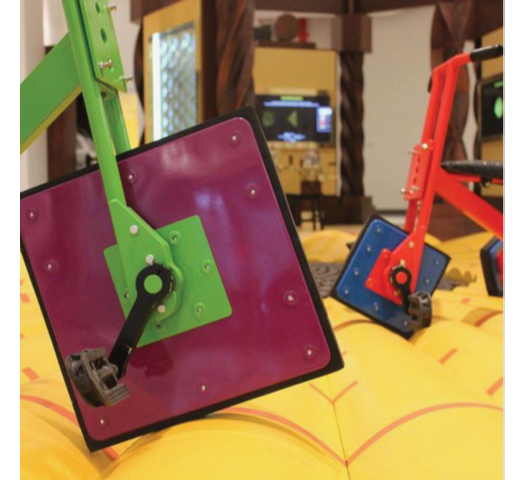
Take a smooth ride on square wheels!
Come explore how mathematics illuminates the patterns that shape the world around us.
Everyone knows you can’t ride a bike with square wheels… right? Amazingly, it all depends on the road. On a normal street a square wheel would lurch from corner to corner, but on the special curved track before you, the ride feels smooth.
You’ve noticed that the track is not flat: each dip follows an inverted catenary — the same curve a hanging chain makes, flipped upside-down. As a square rolls, every time a corner touches the road the catenary sinks just enough to keep the wheel’s center at the same height, so the axle glides forward without bobbing.
Take a ride on the trike and feel an “impossible” idea become perfectly natural.
Surprising Truth: Round wheels suit flat roads; square wheels need matching roads. Change the track and almost any regular polygon can roll smoothly: pentagon wheels ride a chain of gentler catenaries, hexagons gentler still. Only a triangle fails — the dips would be too sharp and the wheel would jam.
_____________
More Math
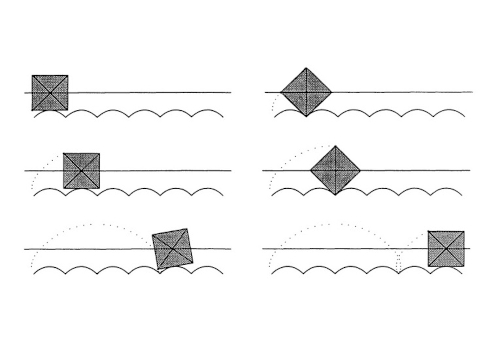
One simple rule — keep the axle at the same height — turns “impossible” wheels into smooth riders.
A square wheel meets a road made of identical valleys. Each valley is a special shape known as an inverted catenary — the upside-down shape a hanging chain makes. Whenever a corner sits in the bottom of a valley, the road has dropped exactly the right amount to keep the wheel’s center perfectly level. Corner after corner, valley after valley, the ride feels as smooth as if the wheels were round.
One simple rule — keep the axle at the same height — turns “impossible” wheels into smooth riders.
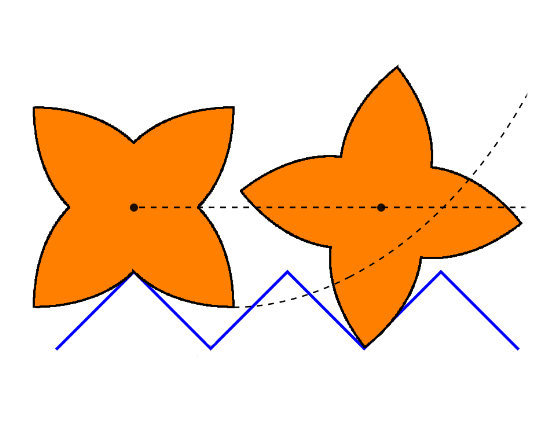
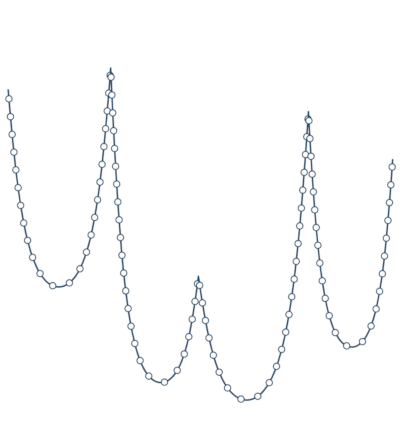
Not all smooth rides need catenaries. A four-petal wheel rolls perfectly on a wide zig-zag track; add a fifth petal and the zig-zags simply tighten. Each point of the “flower” drops into the next V-shaped dip, lifting the opposite petal by exactly the same amount. Because every bump meets its matching groove, the axle (thin line) stays level and the blossom glides forward without a wobble — proof that any wheel can work if the road is cut to fit.
What is a catenary — and how did anyone figure out it would smooth the path for a square wheel?
Start with a hanging chain
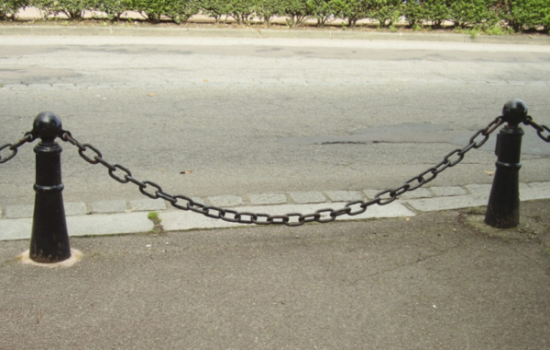
Fasten a chain between two posts and let it droop. Gravity pulls it into a smooth, even “smile” called a catenary (pronounced cat-uh-NAY-ree). Turn that curve upside-down and you get a perfect arch — strong enough to hold up cathedrals and garden roofs.
Set ‘the axle’ challenge
Mathematicians asked, “What kind of road keeps a square wheel’s axle from bouncing?” They wrote equations that measure how high the axle sits at every moment. The goal: find a road shape that keeps that height exactly the same.
Do the heavy lifting with calculus
Using ideas from a branch of mathematics called ‘calculus’ that deals with tiny changes, slopes, and curves, they discovered that the dip under each corner must follow the very same shape as the flipped chain. In other words, the “impossible” square-wheel road was hiding in plain sight.
Why it matters
Matching the square’s corners to a chain-shaped road lets the wheel glide as smoothly as any circle. The same curve keeps real arches standing tall and helps engineers design parts that move without vibration.
Why not a square-wheeled bicycle?
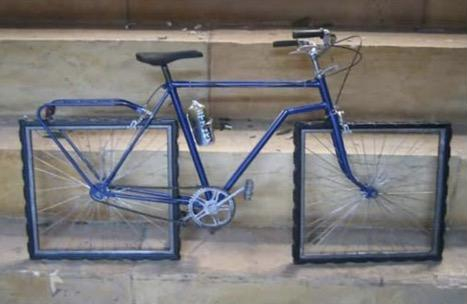
A bicycle must steer, but square wheels demand their own precisely spaced valleys. Turning would yank a wheel out of its lane and bump into the wrong part of the track. A tricycle’s fixed frame keeps each square in its matching lane, letting riders feel the magic without needing to turn.
Why three different-sized square wheels?
Square wheels of different sizes need valleys of different depths and widths.
The tricycle rides on three lanes, each scaled to its wheel. A single bicycle frame couldn’t hold lanes far enough apart for steering, so three wheels in a rigid triangle is the simplest way to show all sizes at once — and to prove the axle-level trick works at any scale.
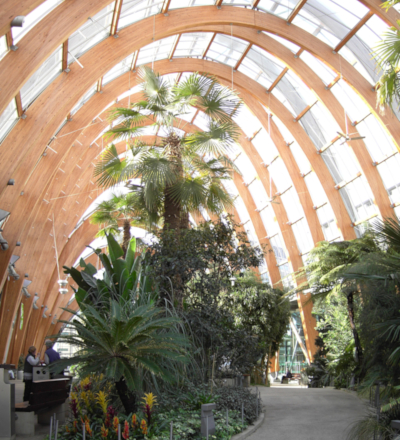
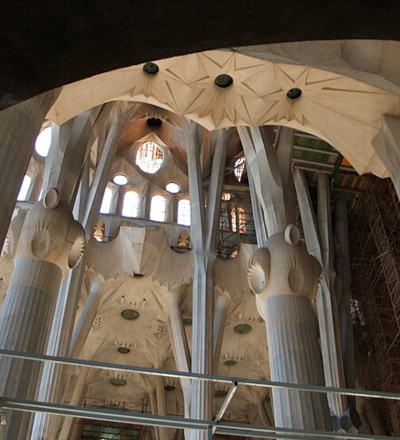
Architects invert catenaries to build arches that carry only vertical compression — no outward push. Gaudí used hanging-chain models for Sagrada Família; modern engineers repeat the trick for train sheds and glass-and-timber roofs like the one shown here.
Fun fact: catenary comes from the Latin word catena, meaning “chain.”
_____________
Gallery
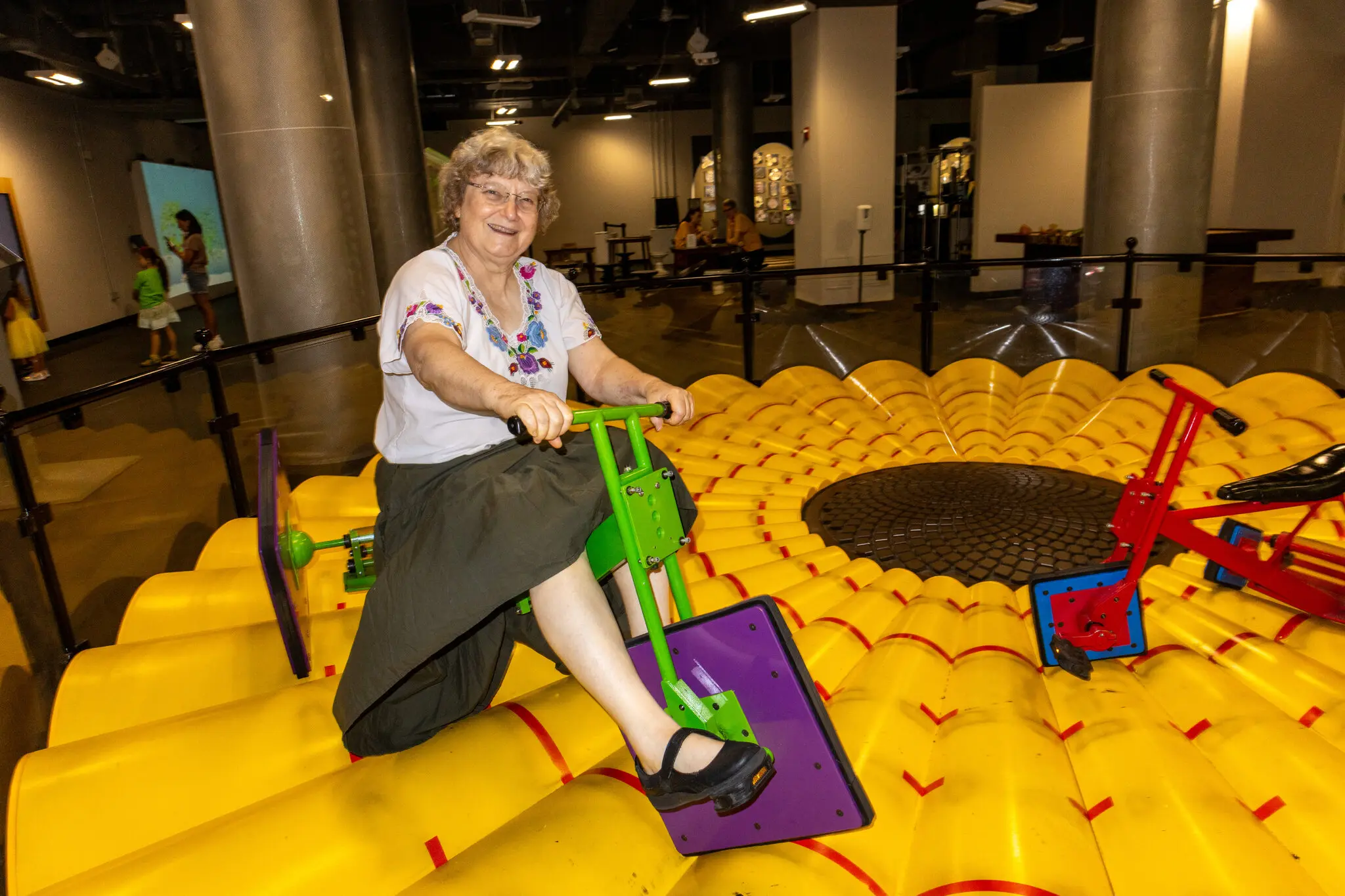
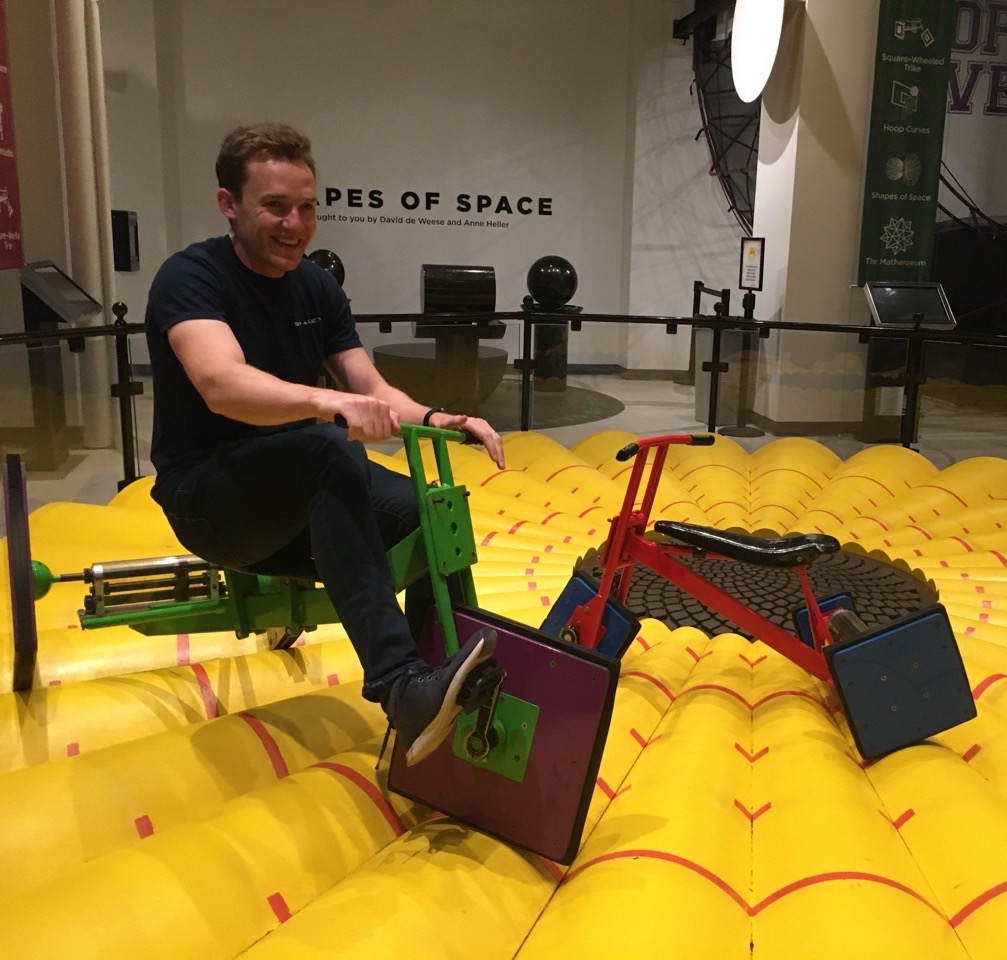
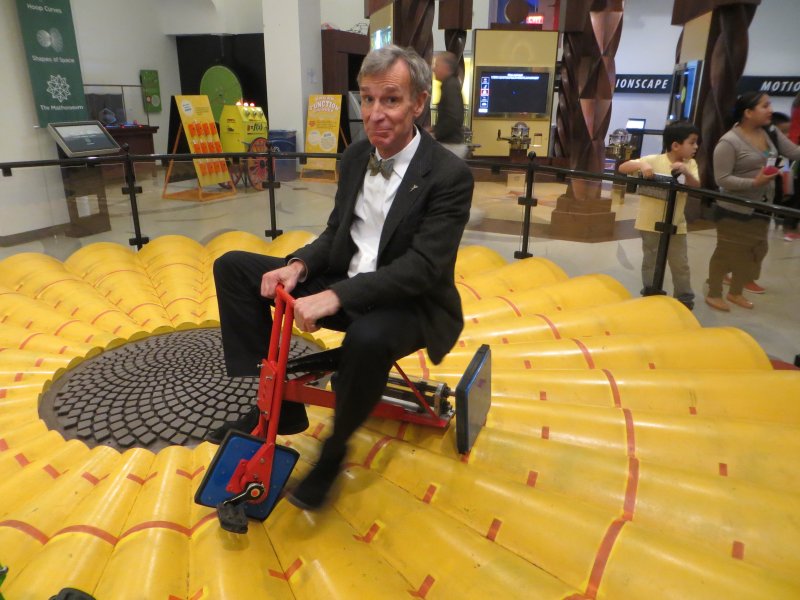
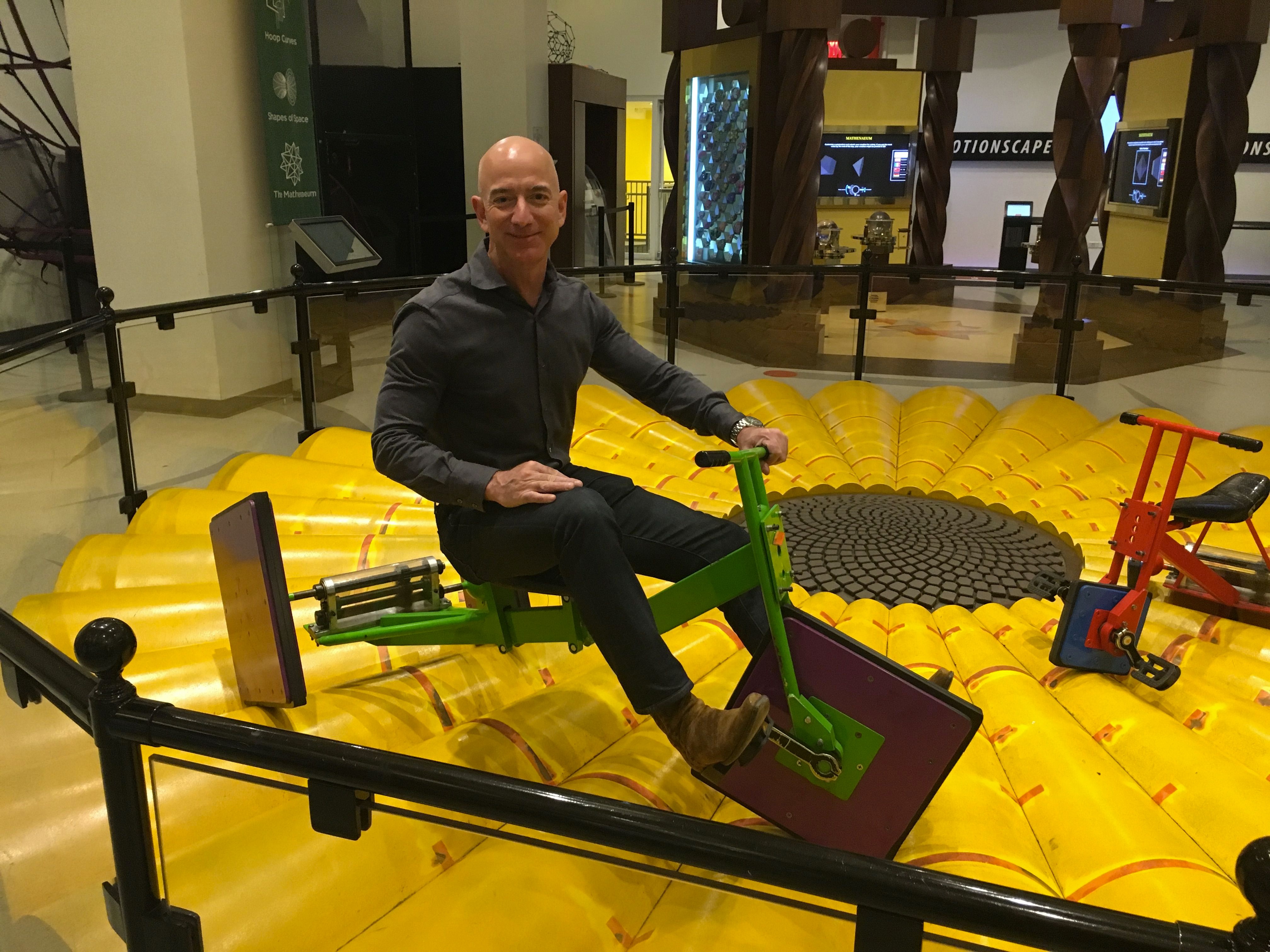
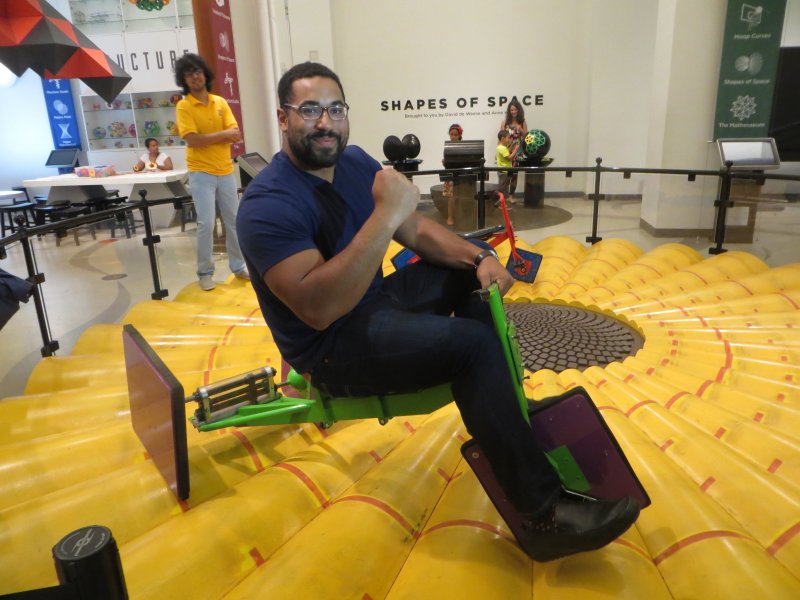
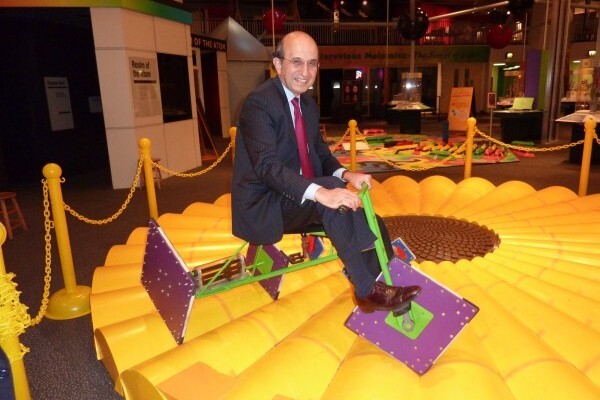
Look who’s ridden the Square-Wheeled Tricycle!

_____________
History
17th century: Discovering the catenary
Scientists studying a hanging chain realized its graceful “sag” was not a parabola. Galileo named the curve, and Huygens and Leibniz worked out its exact shape — today called the catenary, from the Latin catena (“chain”). That discovery gave engineers a brand-new tool for shaping strong arches.

19th century: Flipping the curve sky-high
Builders learned that an inverted catenary carries weight purely in compression, so stone arches and modern icons like Saarinen’s Gateway Arch rise safely with minimal material. The same upside-down chain that steadies a cathedral vault will, one day, guide a square wheel.
1960s-1990s: Riding on squares
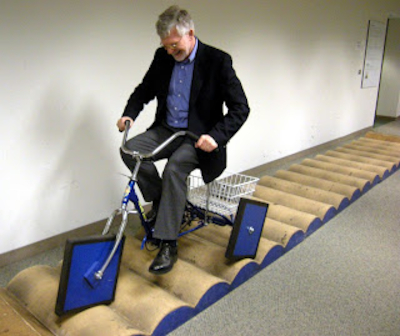
In 1960, mathematician G. B. Robison asked and answered a wonderfully counterintuitive question: can a square wheel roll smoothly? He showed that it can, if the surface beneath it is shaped as a series of catenary dips that keep the axle level. The Exploratorium in San Francisco later brought the idea to life in a small working model, and mathematician Stan Wagon extended it into a striking full-scale realization: a square-wheeled tricycle.
_____________
People

Mary Cartwright
British mathematician and trail-blazer in differential-equation theory (first woman to lead the London Mathematical Society). Her work on how curves behave under changing forces laid the groundwork for matching square wheels to catenary dips.

Eero Saarinen
Architect of the 630-foot Gateway Arch, the world’s tallest inverted-catenary monument. His stainless-steel landmark shows the same curve that lets our trike roll also holds up a national icon.
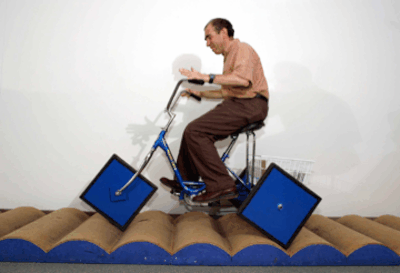
Stan Wagon
Macalester College professor who built the first rideable square-wheeled bicycle in the 1990s, proving on camera that a square really can glide if the road is shaped just right.
Gerson B. Robison
Mathematician G. B. Robison gave the classic published solution to the square-wheel problem in his 1960 paper “Rockers and Rollers,” showing that a square wheel can roll smoothly on a properly shaped series of catenary arches. Later mathematicians and expositors have cited Robison’s paper as the foundational reference for the idea.
_____________
Uses

Precision engineering
Camshafts in car engines use custom-shaped cams that push on followers in a way that keeps the valve rod moving at constant speed or constant height — just like the trike’s axle. Designers solve the same “track-for-wheel” equation to get vibration-free motion at 6,000 rpm.
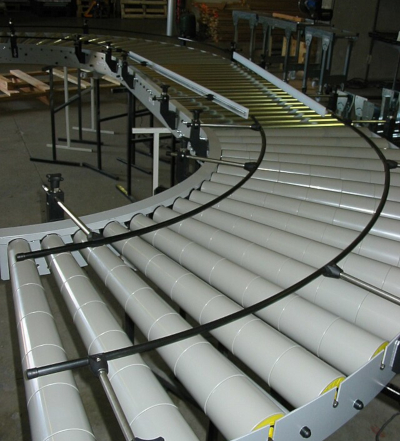
Conveyor rollers
Bottle plants and printing presses sometimes run products along grooved tracks with non-round rollers so the load stays level while changing speed. Matching profiles prevent spills and smears.
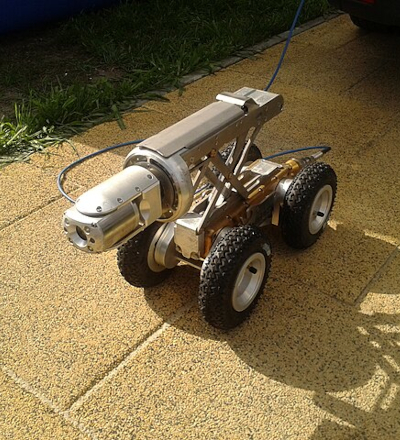
Robotics
Small inspection robots roll inside pipes on polygonal wheels paired with scalloped rails; the arrangement keeps sensors centered even while climbing steep inclines.
Architecture
Inverted catenaries appear in Gaudí’s Sagrada Familia, Saarinen’s Gateway Arch, and countless masonry vaults because the shape carries weight purely in compression, allowing elegant spans with minimal material.